


In our program we will help you teach your dog skills to help manage your dog’s reactivity and make navigating the world easier. Training these skills is very important but it’s not the whole picture. We will also be utilizing management to restrict how much rehearsal our dog gets of unwanted behaviors along with behavior modification to change how our dog actually feels about triggering situations.
Trigger Detox:
As we discussed in an earlier section, hormone levels can stay elevated in your dog for days after having a reaction to one of their triggers. This is why I often recommend giving your reactive dog a walking detox of at least a few days if not a week or two to help reset their cortisol level. This time can also be used to start teaching the needed foundation skills.
I often get push back, but “my dog needs exercise”, yes dogs definitely need some sort of daily exercise, but believe it or not there are ways to achieve that without walking them.
If taking a walking / trigger detox you can:
- Walk your dog at off hours. This may mean rearranging your schedule and/or getting up at 4 am, but it can be done.
- You can also take your dog to places you are extremely unlikely to see their triggers such as an industrial park after hours.
- You can rent a private space for your dog to run – Sniff spot offers some private space rentals or you can book time at our facility: https://twopaws-up.com/services/ring-rentals/
Additional Management will be discussed in the next section and it plays a vital part in all behavior modification plans.
Physical Vs Mental Stimulation
It is also important for every dog, but especially our reactive dogs, to have proper mental exercise daily. If you are walking your dog and not allowing them to sniff and smell or investigate things on your walk, they are not getting that mental component.
Mental exercise is actually more important than physical exercise for our fearful and reactive dogs. Working out their brain can tire them out in much more beneficial ways. It can help regulate those hormones we are so focused on. So how can we work their brains?
- Training
- teaching your dog the foundation skills we need for our behavior modification plan
- teaching your dog fun tricks
- shaping is the best way to teach your reactive dog!!
- Food & Chews
- Games & Puzzles involving food
- Food dispensing toys – stop feeding your dog from a bowl!
- Chewing is a very mental activity for dogs
- Nose Work
- When dogs search they use their brain and their nose! Both are very beneficial for our fearful and reactive dogs.
- You can hide food and treats around the house, in boxes, etc.
- You can join a Nose Work Class
- If you find a CNWI – Certified Nose Work Instructor – their classes should be structure in such a way that even a reactive dog can join.
- https://twopaws-up.com/services/classes/canine-sports-classes/nose-work-classes/
Equipment
When working with a reactive dog, equipment matters. Using anything that causes pain or fear for the dog should be avoided. Even regular flat collars can be problematic for dogs who are pulling and lunging at the end of their leash. We do want to address walking behaviors, but that takes time to build.
In the meantime, we always recommend getting your dog on a harness with both a front and back clip. The front clip should help reduce the pulling.
Muzzle Training
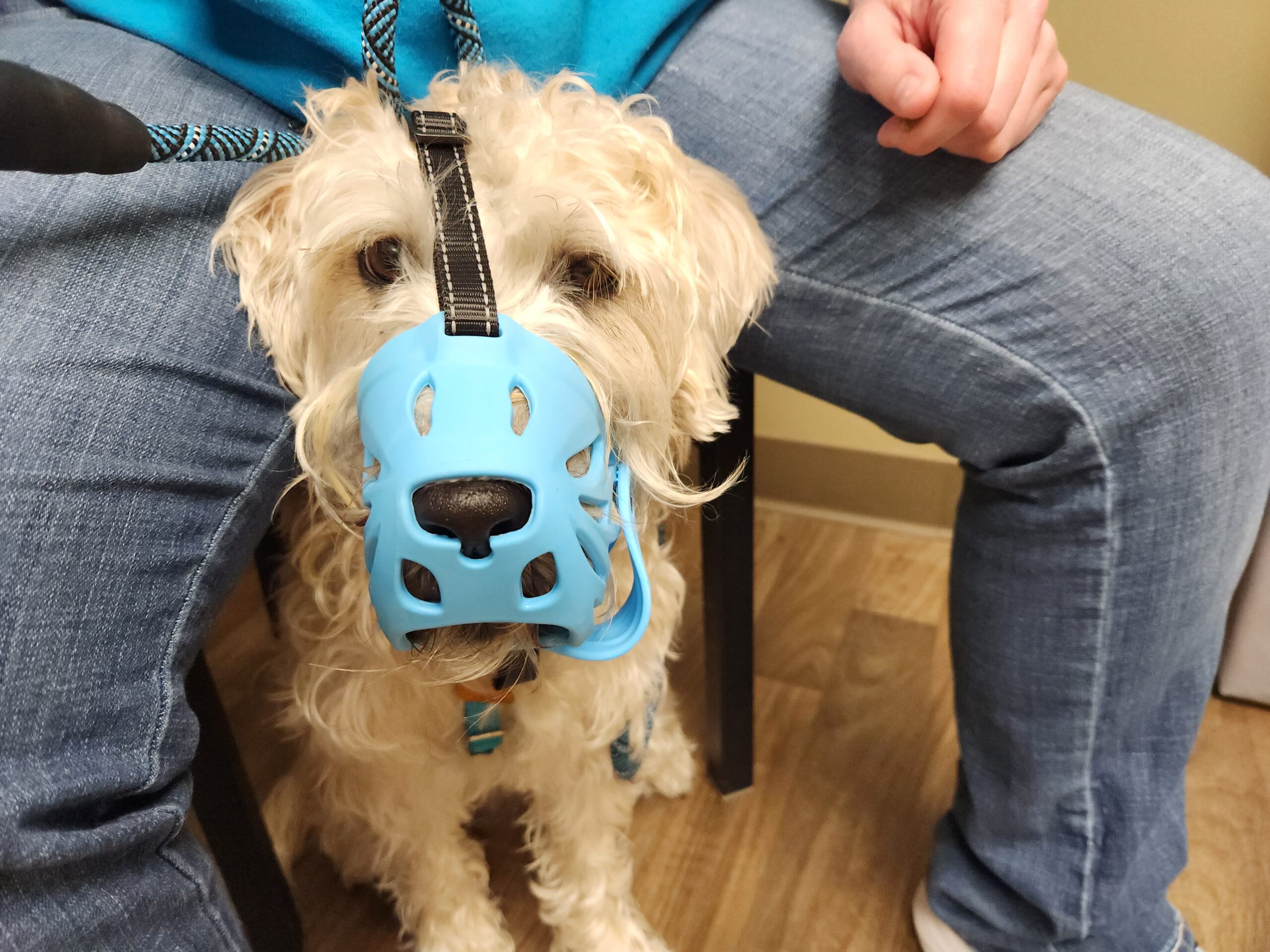
Muzzles can be controversial, but I have had a couple of my own dogs who have had to be muzzled at the vet. I believe that every dog should be able to wear a muzzle without it causing too much added anxiety. Muzzles can give us that added piece of security when working with a truly aggressive dog. Safety is of course our top priority.
Basket muzzles are always recommended as they allow the dog to open their mouth to pant and breathe normally as well as take treats.
Here is my favorite style – https://amzn.to/3Yv8ylc
Baskerville is another often recommended brand. I have found they can be hard to fit on our longer nosed dogs and many dogs don’t tolerate them well because they are very hard rubber. They are definitely recommended for our large powerful breeds – https://amzn.to/3qBl0TY
It is important to properly train our dogs to accept any muzzle we are going to use. Here is a great website to help with that – https://muzzleupproject.com/muzzle-training/